


Nov
Are We Seeing The Start Of The AI Pullback?
jerry9789 0 comments artificial intelligence, Burning Questions


What Is AI Pullback?
In these last few years, we’ve all heard nothing but the revolutionary and transformative influence of Artificial Intelligence not only in the mainstream consciousness but also in various industries. A mixture of excitement and anxiety, we’ve collectively marveled at what Generative AI could produce or emulate in little to no time at all while grasping at the notion of what all this automation means for the human workforce and talent. However, the tone appears to be shifting these past few months with data showing large companies’ adoption of AI on the decline.
As reported in Apollo, a biweekly US Census Bureau survey of 1.2 million firms revealed a downward trend in AI utilization for companies with more than 250 employees. Falling from about 13.5% in June to under 12% in August, it’s the largest decline for AI adoption since the survey started in November 2023. Mid-sized companies or firms with less than 250 employees but more than 19 workers showed decreasing or stagnating AI adoption. It’s only with small companies with less than four employees that demonstrated a slight increase in AI usage.
New reports might help shed light on the AI pullback, such as a recent one from MIT indicating that 95% of AI pilot programs failed to boost company revenues or productivity. MIT’s findings were based on reviews of over 300 public corporate AI usage, surveying 350 employees, and talking with 150 industry leaders.
A recent study by METR revealed that developers surprisingly took 19% longer to complete issues when using AI coding tools than without. Yet despite actually experiencing slowdown, the developers still believed AI sped them up by 20%. This gap between developers’ perception and reality is representative of these past few years with the hyped up implementation of AI into everything software-related and unrestrained confidence in the hot new tech in spite of the unfavorable results.
IT Consultancy Gartner also attempted to quantify how much work AI agents get wrong when it “hallucinates.” They found that generative AI performs office tasks wrong a staggering 70% of the time. With that much error, human oversight becomes a necessity and in some cases, objectives would’ve been served much better had the task been assigned to a person instead of a machine.

Image: Mathias Reding
Is AI Pullback A Sign Of AI Adoption Maturity?
On a different note, the MTLC wrote that the AI pullback might seem like a slowdown but it could actually be a correction or calibration, as is the natural progression with any emerging tech’s usage. They pointed out that the same MIT report accounted for over 90% of employees using AI tools, no matter the company stance with AI. That these workers would utilize AI just so they can perform their tasks more efficiently and faster. And that this is another way at looking at AI adoption- “bottom-up, not just top down.”
It’s not that AI isn’t viable, but rather “the projects weren’t scoped, aligned, or designed for outcomes.” 95% of AI projects fail not because of the technology but because of how companies approach AI adoption.
AI pullback is signaling the transition from overenthusiasm to realistic expectations, from experimentation to production. For enterprise businesses to succeed with AI, they would need to identify which models, tools and processes work, which projects to invest in, and where AI would deliver the most value.

Image: Andrea Piacquadio
Cascade Strategies’ Approach To AI
The promise of increased production and revenue had led to companies to replace or cease hiring human workers in favor of AI during the onset of its mainstream popularity. Now that AI pullback is happening, companies have begun hiring human workers again not only to oversee but fix or improve sloppy AI outputs.
Cascade Strategies has always approached AI not just merely as a tool but as an augmentation and extension of human intelligence and talent. Yes, AI is a very powerful and promising technology but we recognize early on that on its own, it is gravely limited to the datasets its fed and their quality, the eventual gaps providing the perfect breeding ground for “hallucinations,” each iteration degrading and becoming less of what was before. We’ve always seen human intervention and guidance as essential for AI to maximize its potential; with the AI pullback, more and more companies are on the brink of discovering this incredible synergy between human and artificial intelligence.
Powered by AI, research becomes scalable and cost-effective by being applicable in all facets of the business and not just flagship projects; human oversight amplifies all that productivity and efficiency by unlocking innovative, resonant and actionable insights.
If you would like to learn more about how our human-centered market research work can benefit you or your company, feel free to contact us here.

Image: cottonbro studio
Additional Reading:
AI Pullback Has Officially Started – Will Lockett, medium.com Oct. 22, 2025
Data Shows That AI Use Is Now Declining at Large Companies – Joe Wilkins, futurism.com Sep. 8, 2025
AI adoption slows among big firms, U.S. data shows – Jullianna Anne Briones, tech.co Sep. 18, 2025
US Census Bureau: AI Adoption Has Declined for Large Companies – Conor Cawley, Sep. 11, 2025
AI adoption rate is declining among large companies — US Census Bureau claims fewer businesses are using AI tools – Hassam Nasir, tomshardware.com Sep. 8, 2025
Featured Image: MrWashingt0n
Top Image: Thirdman

Mar
4 Trends Indicate AI Is Disrupting Labor Market
jerry9789 0 comments artificial intelligence, Burning Questions

Is AI going to disrupt the labor market? Researchers think it has already started to do so.
Harvard economists David Deming and Lawrence H. Summers, along with Kennedy School predoctoral fellow Christopher Ong, have presented a new paper that looks at over 100 years of “occupational churn” for a study of technological disruption. “Occupational churn” refers to each profession’s share in the U.S. labor market, which Deming and Summers have always been interested in gauging. With the help of Ong, they applied the metric to 124 years of U.S. Census data, initially sharing their findings in a volume published last fall by the Aspen Economic Strategy Group.
So are robots going to take over human jobs? This sentiment has always been present, and for good cause, whenever breakthrough technologies such as keyboards, electricity, and computer-based manufacturing emerge. The 1950s, ’60s, and ’70s demonstrated volatility that surprised but eventually made sense to Summers, while Deming characterized the 2000s and 2010s as having “automation anxiety.” The study, however, revealed that the labor market enjoyed stability and low churn between 1990 and 2017, when the pace of disruption slowed.
But for 2019 onwards, it appears that there’s a major change set to happen, with four labor market trends pointing towards AI as the new breakthrough technology.
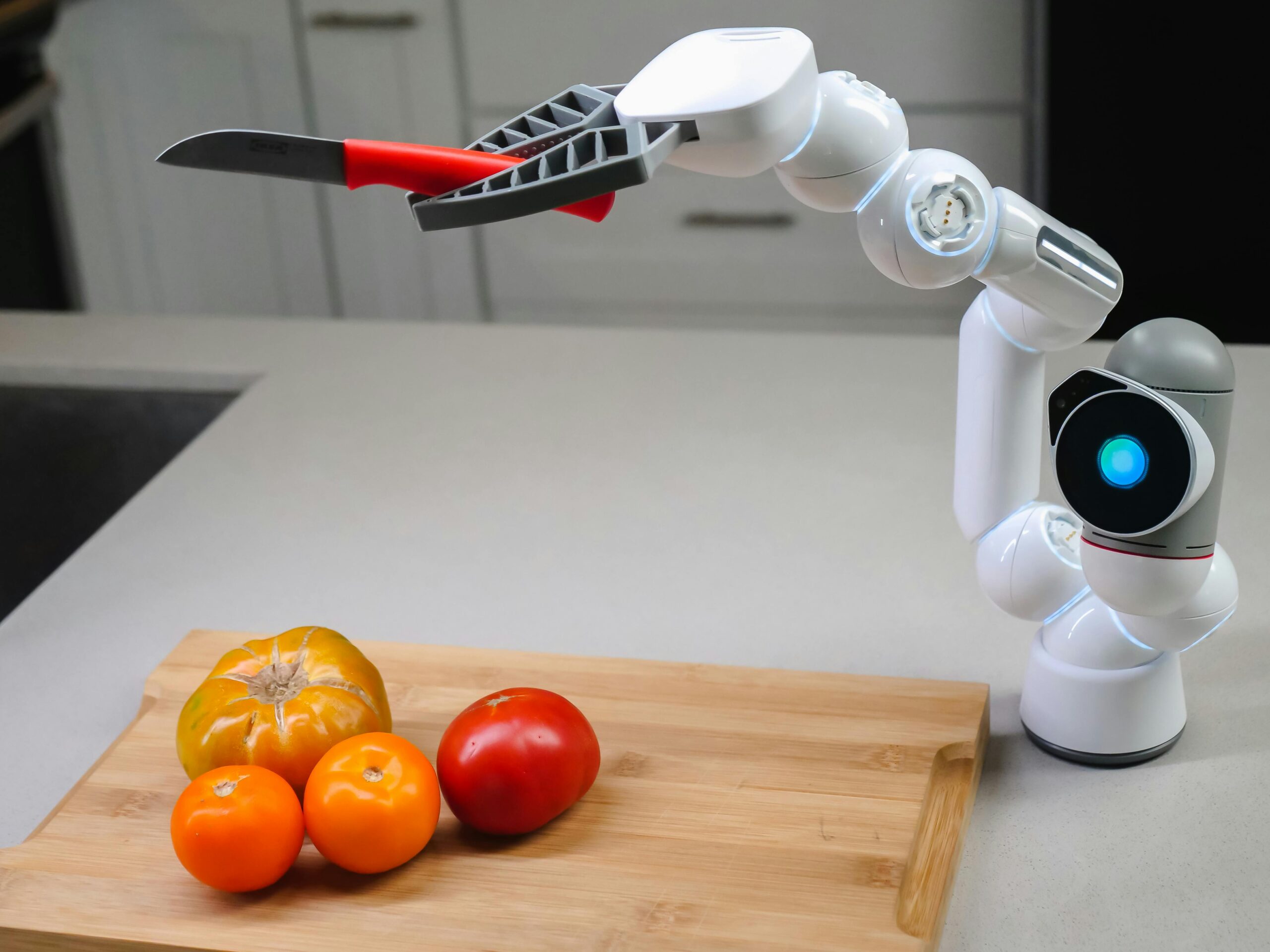
Copyright: Kindel Media
1. High-paying jobs are on the rise
The first trend sees job polarization being replaced by general skill upgrading. Job polarization refers to increased employment opportunities in the high- and low-skill occupations, while middle-skill jobs go through a relative decline. Extending across multiple decades and various economic states, this phenomenon has been influenced by technological shifts such as manufacturing automation and the widespread adoption of office software.
However, the report noted that between 2016 and 2022 low- and middle-skill jobs have both declined, while high-skilled, high-paying jobs have slightly increased. The report adds that data collected through 2024 show similar results, denoting the end of polarization as of 2016 and the start of a trend toward skill upgrading.
2. Low-paying service work employment is flat or in decline
Job polarization during the 2000s was seen as a result of middle-skill production jobs being replaced by low-paid service work. Low-skill jobs enjoyed robust growth during the 2000s but slowed in the early 2010s and was flat throughout the rest of the decade, falling rapidly in 2020 when the COVID-19 pandemic happened. While low-paying occupations have partly recovered in 2024, most service sector employment is back to the same level it started at before its rapid growth back in the 2000s.
The decline in low-paying service work can’t be pinned solely on the emergence of AI, however, as other factors include the aforementioned pandemic disruption, increasing wages, and a tighter labor market.
3. STEM occupations are on the rise
After a decline in the 2000s, STEM (science, technology, engineering, and math) jobs are now enjoying rapid growth from 6.5 percent in 2010 to nearly 10 percent in 2024. This growth also extends to business and management occupations such as science and engineering managers, management analysts, and other business operations specialists.
Firms have also increased their investments in AI-related technologies to match the rising number of technical talents they’re hiring and developing. Mostly driven by the need for more computing power, software and information processing investments are now above 4 percent once again — the same level they were at prior to the bursting of the dot-com bubble and the 2001 recession — while research and development spending as a share of GDP has now reached a record high of 2.9 percent.
4. Retail sales jobs are in decline
Even before the pandemic, retail sales occupations had been declining. Retail sales jobs dropped by 850,000 between 2013 and 2023, which translates to a decrease from a 7.5 percent share to a 5.7 percent share of employment and represents a 25 percent reduction of share in the job market in just a decade.
This reduction is seen as one effect of e-commerce’s early adoption of predictive AI models around the mid-2010s to generate personal recommendations based on customers’ browsing and buying histories, along with predicting local product needs for stocking warehouses. Online retail has more than doubled its share of all retail sales, increasing to 15.6 percent from 7 percent in 2015.
Meanwhile, retail labor productivity has increased while the number of jobs declined, mimicking what had happened with manufacturing production jobs 50 years prior. Online retail’s demand for light delivery service truck drivers for their last-mile package delivery and “stockers and order fillers” in their large warehouses resulted in employment growth in these occupations.

Copyright: u_fg0tkeqgiy
Conclusion
Is AI going to replace you at work? Looking at these four trends, the answer is going to depend on what you do for a living.
Summers pointed out that that “highly empowering” forms of AI might be so transformative that “certain types of activities simply won’t be done by people anymore.” Data exists to corroborate the assertion that automation claims jobs, Deming citing early 20th-century telephone operators in a Substack post. The study notes that sales and administrative support occupations may experience future declines in employment as AI innovates and improves on certain tasks — for example, personalized product recommendations, rapid pricing adjustments, inventory management, transcription, and automated scheduling.
As AI is increasingly used to boost productivity, there are some tasks where it still might not be as effective as humans. Based on this observation, some firms may conclude that, rather than replace human knowledge workers with robots, it might be wiser to simply increase their expectations from their human workforce. This is one of the reasons the study recommends higher levels of public and private investment in STEM education, reasoning that such training and reskilling of workers will help them adapt to a world in which the new technologies are here to stay.
Additional Reference Article: Is AI already shaking up labor market? – The Harvard Gazette, Christy DeSmith (February 14, 2025)
Featured Image Copyright: Frank_Rietsch
Top Image Copyright: ThisIsEngineering







 info@cascadestrategies.com
 2032 Newport Way NW,
Issaquah, WA 98027 (425) 677-7430