


Aug
How Excellent Market Research Benefits Manufacturing Companies
jerry9789 0 comments artificial intelligence, Brandview World, Burning Questions


More than just an invaluable asset, market research is an essential tool to any company — or industry, for that matter. From identifying and tailoring your messaging towards your ideal customer with consumer research to understanding the competition and strategically positioning your company with competitor research, great market research grants you and your firm vital and actionable insights that would prove key to the success of your marketing efforts. In addition, excellent market research helps companies manage risks effectively and efficiently, as well as aid in measuring the progress and success of projects or even your company as a whole.
The manufacturing industry not only stands to benefit from high quality market research, it’s crucial to its continued growth, innovation and evolution, especially in an industrial landscape that’s continually transforming with technological advancements along with global, cultural and attitudinal shifts. From the steam and watered-power machines of the First Industrial Revolution to the expansion of network systems and electrification of the Second Industrial Revolution to the information technology focus of the Third Industrial Revolution (the Digital Revolution), the manufacturing industry’s evolution continues on in its latest iteration with Industry 4.0, harnessing modern and emerging technologies to facilitate the merging of the physical and digital realms.
And on that note, we take a look at 10 manufacturing industry trends today that exceptional market research can help manufacturers navigate and adapt to as the Industry 4.0 era unfolds.

Image: Livia Wong
1. Smart Factories
Perhaps the best representative of things to come with the Fourth Industrial Revolution, smart factories utilize Industry 4.0 technologies to streamline and improve operational efficiency, quality and maintenance while reducing errors and waste. Older machines are gradually giving way to newer counterparts built with onboard sensors, monitoring tools, interconnected systems and in some cases, machine learning capabilities.
With more and more manufacturing companies transitioning to automated facilities plus the decreasing costs to acquire sensors, software and equipment, manufacturers big and small are all the more incentivized to join the smart factory revolution — if they haven’t yet — to not only keep up with the competition and the changing times but also take advantage of the irresistible operational benefits.
2. Artificial Intelligence
AI has disrupted multiple industries, and manufacturing isn’t immune to it; in fact, it has openly and quickly embraced and adopted it, seeing all the tremendous advantages it brings with its data-crunching prowess and advanced decision-making insights to the core aspects of smart production, quality control, supply chain management, servicing and maintenance, along with enhancements to processes, products and services.
More and more manufacturing companies are finding success and are able to scale competitively when strategically leveraging AI in automating and streamlining their operations, especially when it’s combined with other contemporary technologies. But perhaps the best combination of them all is when AI is combined with human creativity and experience, opening doors for innovation and further advancements.
3. Digital Twins and Data-driven Predictive Maintenance
If smart factories are revolutionizing manufacturing operations, digital twin technology and data-driven predictive maintenance are transforming equipment maintenance and operational downtimes. By utilizing virtual replicas or “digital twins” of equipment and devices, manufacturers can simulate equipment performance under different scenarios and situations to gain valuable insights. These data-driven insights would help manufacturing companies anticipate or predict when an equipment would need servicing or maintenance, reducing or eliminating unexpected downtimes and equipment breakdowns. At the same time, maintenance costs are reduced, material cost savings are increased, and the usage or life cycle of the asset is optimized.
And digital twins aren’t limited to physical assets only, as they can also replicate systems or processes to test new ideas or optimize existing ones before applying any changes or updates to live production. The digital twins approach not only helps minimize resource consumption and waste, but also improves business decisions by backing them with data-driven insights.
4. Other Notable Industry 4.0 Technologies (AR/VR/Robotics)
Arising from the realms of gaming and entertainment, augmented reality (AR) and virtual reality (VR) have now begun revolutionizing manufacturing. Product design, quality control, maintenance and repairs, remote collaboration and even employee training — all these are being impacted and improved by the application of AR and VR technology.
Robotics may have been around longer than AR and VR but modern robots are far more advanced than their forerunners programmed for repetitive tasks. Thanks to AI and automation software, today’s robots are autonomous, collaborative, and far more capable of performing complex tasks and operations.
These technologies in conjunction with AI make it possible for manufacturing operations to be run remotely or without any operator onsite. And as these technologies grow popular to become widely used and accepted, we might even see more fully automated manufacturing facilities called “dark factories” be developed in the near future.
5. Sustainability and Carbon Neutrality
No other industry is perhaps under greater pressure to pursue sustainable processes and carbon-neutral practices than manufacturing. Contracts with governments and institutions and eventually commercial clients require compliance with sustainability efforts while more and more consumers are supporting reputable, sustainable brands.
The manufacturing industry itself is advancing sustainability efforts by developing and employing green software to aid with carbon neutrality, waste reduction, and energy consumption optimization. Renewable energy integration in physical locations is also being embraced, while cloud infrastructure solutions and carbon capture technology are being viewed for their potential. Working toward sustainable practices and carbon neutrality isn’t without its own rewards for the business, as it’s been found that eco-conscious manufacturing companies are able to significantly reduce costs and improve efficiency with their sustainability efforts over time.
6. Reshoring
Reshoring refers to returning production operations back to the manufacturing company’s home country from overseas locations. This trend was a result of recent global events disrupting supply chains. It benefits the manufacturer with shorter supply chains, better quality control, faster market delivery, domestic economic boost, and improved sustainability efforts.
However, reshoring isn’t a decision a manufacturing company should take lightly, as one would need to factor in labor costs, skill, infrastructure, and more, as smaller-scale firms might find it more costly to operate domestically than overseas.
7. Decentralized Manufacturing
Another approach to improving supply chain resilience from disruptions is decentralized manufacturing, which is the distribution of production activities across multiple locations in the form of microfactories. Additional benefits of decentralized manufacturing include reduced logistics costs and quicker response times to local market demands.
While the coordination of multiple microfactories and achieving standardization across all sites may prove to be challenging, Industry 4.0 technologies can aid in making decentralized manufacturing more accessible and manageable through improved transparency and responsive production models.
8. Tapping into B2C
With the ever-growing popularity of e-commerce, manufacturing companies can now bypass the traditional lines of retailers and distributors and sell directly to the end consumer. Smart factories, 3d printing and additive manufacturing also make it possible to offer customized products based on a customer’s preferences. The advent of new manufacturing technology or the evolution of existing ones would only open up more opportunities for enterprising manufacturers looking to connect further with consumers.
9. Cybersecurity
The manufacturing industry’s increasing digitization has made it an irresistible target for cybercriminals, exploiting vulnerabilities with cyberthreats and attacks ranging from ransomware to industrial espionage or even supply chain and/or operational disruption. It’s no surprise then that cybersecurity has joined the elite group of paramount concerns for any manufacturing company.
Measures include multi-layered security, secure-by-design, zero-trust architecture, AI-driven threat detection, advanced encryption, and regular updates and patches, as well as employee cybersecurity training. Cybersecurity is more than just data protection or an IT concern now for manufacturing companies as it safeguards their production, finances, integrity, and reputation.
10. The Workforce of Industry 4.0
In spite of all the exciting technologies emerging in the Fourth Industrial Revolution, the manufacturing industry is experiencing widening skills gaps and labor shortages. These difficulties could translate to a loss in revenue of $1 trillion if approximately 2.1 million jobs aren’t filled in by 2030.
To address these challenges, manufacturing companies could start with reviewing all of their production processes from the ground up and assessing areas that could be improved by a highly skilled and competent workforce. Yes, the manufacturing industry is moving towards automation and advanced technologies but it can’t truly innovate without human creativity and experience.
Manufacturing companies are planning to offer higher wages by at least 3%. At the same time, they’re investing in training programs to reskill or upskill existing employees for the Industry 4.0 work environment. Incorporating new manufacturing technologies like AI and AR in these training programs can help employees not only learn faster, but also give them familiarity and first-hand experience with these digital trends. The same technologies can also be deployed for improving employee health and safety at the workplace.
Other approaches that manufacturing companies can consider taking range from partnering with local educational institutions in creating curriculums tailored for manufacturing careers, diversifying the recruitment pool, and creating appealing work environments which offer flexible schedules, potential promotions, and career development.

Image: InWay
How Cascade Strategies Can Help Manufacturing Companies with Advanced Market Research
Hewlett-Packard wanted to discover what feature-price combinations in high-frequency oscilloscopes would optimize profit. We conducted an advanced conjoint study followed by AI-based modeling to evaluate sales scenarios. Out of hundreds of attributes, we found the qualities below to be most salient. Using the most salient attributes as predictive vectors, we developed an AI model to determine the unique price-feature combinations that would produce the most profit and presented the top 3 to Hewlett-Packard.
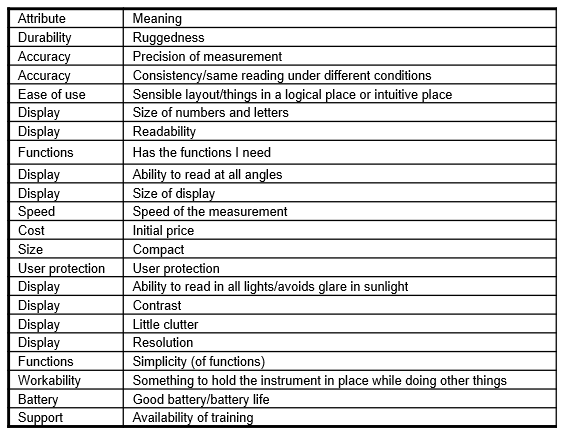
We’ve highlighted 10 manufacturing trends shaping the future of the manufacturing industry in this selection but there are actually more out there that we didn’t touch on. And as new technologies arise, existing ones improve, and other industry changes or shifts happen, more trends are sure to emerge.
Regardless of trends, you can be sure to count on market research to help you determine the best approach to leveraging new technologies or guide business decisions to ensure your manufacturing company stays competitive and relevant. Would it be beneficial or costly for your company to go with a dark factory over a smart factory? Which of your AI-driven production processes would benefit from human supervision and input? Are your sustainability efforts being seen and appreciated by your consumer base or do you need to do more?
Between reshoring and decentralized manufacturing, which one would work best for your company? Are you able to expand into B2C? Are your training programs effective in making your employees understand and uphold cybersecurity commitments?
As with any AI-powered or data-driven Industry 4.0 technology, the high quality market research Cascade Strategies provides grants valuable and actionable insights into the operations, perception, and potential of your manufacturing company. If you would like to find out more about how Cascade Strategies can help your manufacturing company thrive in the Fourth Industrial Revolution, please contact us here.
Featured Image: Hyundai Motor Group
Top Image: Foto-Rabe

Jul
How Market Research Benefits Telecommunications Companies
jerry9789 0 comments Brand Surveys and Testing, Brandview World

The Telecommunications Industry Post-COVID
We’re some years removed now from the COVID-19 pandemic, but from that bleak and forlorn stage in time, the telecommunications industry has proven just how essential its services are to the whole world. It’s always been one of those industries that’s expected to grow steadily through the years given the constant need for communication and connection along with the emergence of new technologies. But probably not everyone prior to the pandemic and lockdown could’ve anticipated just how much growth in some of telecommunication’s notable sectors would skyrocket.
What was once the domain of the select few who opted to work, transact, or learn virtually, remote environments have been elevated from viable options to cornerstone platforms in the plans and strategies of businesses and educational institutions. Streaming services gained more popularity during the lockdown, rewriting the book on how we access and enjoy entertainment from that point onward. More and more smart devices are being introduced to the market along with the proliferation of Internet of Things (IoT) applications like security systems. From video conferencing to online collaborations, from seamless viewing experiences to uninterrupted real-time data transmission, providing stable and reliable connections is paramount for the continued success and growth of any telecommunications company.
But beyond that, a telecommunications company must also be able to look forward and recognize areas where it can grow further as well as anticipate any possible changes that could affect the industry, such as shifting attitudes and market trends, lest they fall behind and be overtaken by the more prepared and forward-thinking competition. Telecommunications market research is a vital key in helping a telecommunications company thrive amid an ever-changing landscape while staying relevant and competitive.

Copyright: Yan Krukauo
How Market Research Helps Telecommunications Companies
Great research helps telecommunications companies in a number of ways. A chief benefit from telecommunications market research is discovering and understanding changes in consumer behavior and needs via customer feedback, their buying patterns and other sources. And this won’t be limited to just a general overview, as market research can deep dive into each consumer segment or profile to uncover underlying specific needs and preferences.
This would help guide business decisions in determining whether a new product or service has a viable market or an ideal customer segment as well as identify if there’s an opportunity to improve or rethink existing offerings. Concepts that worked back in the pandemic might not be as appealing or practical the farther we move away from that restrictive period of time.
Market research also sheds light on what current and potential customers think of your telecommunications company’s brand. High expectations could mean that your brand is an industry leader or pioneer, giving all the more reason to stay ahead of the competition by exploring opportunities to introduce new products or services before others could come up with similar offerings. Negative perceptions could reveal where your brand is lacking and whether there’s an opportunity for rebranding or how such a reinvention could be accomplished. How your brand is being perceived could also serve as the benchmark for rethinking strategies, pricing, tiers, or packaging. This also extends to capturing the interest and eventual support of consumers on the fence or converting lukewarm clients into steadfast advocates. With customer loyalty in place, a telecommunications company can effectively devise and implement customer appreciation programs and promotions.

Copyright: fauxels
Navigating The Future with Telecommunications Market Research
Telecommunications companies need great market research now more than ever with the emergence of cutting-edge technologies like AI, cybersecurity and edge computing. But more importantly, we’re witnessing the gradual rollout of 5G network and services which support not only enhanced mobile experiences but also IoT, autonomous driving cars, smart cities and more. Great research can help a telecommunications company position itself at the intersection of these new technologies and the consumer market through the development of relevant products, partnering with tech leaders, and the delivery of seamless integration experiences.
And with the world becoming more and more digitally connected, it’s no surprise that cybersecurity and privacy are becoming foremost concerns. Telecommunications market research therefore becomes key in recognizing and addressing customer concerns over the security of their data and information, shaping privacy policies, and guiding business decisions about which advanced cybersecurity measures to invest in. When delivered in relatable and understandable terms to consumers, a telecommunications company’s effort to soothe data security and privacy concerns can convert into the building of trust and goodwill.
An increasingly interconnected world also means that competition can go beyond borders and achieve global scale. Whether a telecommunications company takes a cautious approach or aggressively expands, market research is that indispensable asset informing company leaders and investors on how to safeguard local market shares, navigate regional and regulatory challenges, recognize key competitors, choose potential partners, tap niche markets, and more.

Copyright: Pixabay
Cascade Strategies and Telecommunications Market Research
All over the Internet you’ll find articles and blogs on how to conduct market research, including research for the telecommunications industry. The question is, would you rather conduct this research yourself or would you prefer tapping into telecommunications market research backed by 35 years of experience?
Cascade Strategies brings to the table over three decades of market research experience, which includes case studies for esteemed telecommunications clients like AT&T, Sprint, and T-Mobile. That experience includes not only a variety of primary research methods encompassing traditional qualitative and quantitative approaches, but also leverages cutting-edge technology like AI. This is accompanied by extraordinarily high-level human thinking to achieve “breakthroughs” — actionable, out-of-the-box insights that build and set your brand apart from the competition. Contact us today to learn more how we can help you with your telecommunications market research!

Copyright: Kaboompics.com
Featured Image Copyright: Andres Ayala
Top Image Copyright: wd toro







 info@cascadestrategies.com
 2032 Newport Way NW,
Issaquah, WA 98027 (425) 677-7430