


Jun
How Great Market Research Can Help Food and Beverage Manufacturers
jerry9789 0 comments Brand Surveys and Testing


How do you navigate a market landscape as vast and dynamic as the Food and Beverage Manufacturing industry? How do you introduce your new product or make it stand out from the competition? And how do you keep your offerings or your company itself relevant amidst the fast-changing times?
These questions might make one think that thriving let alone venturing into the Food and Beverage Manufacturing industry would prove to be formidable and intimidating pursuits. But that wouldn’t necessarily be the case if one leverages great market research in their endeavors in Food and Beverage Manufacturing.
From resonating with the right audience to competitively pricing your product, from adapting new and emerging technologies to innovating in an ever-shifting industry, market research would prove key to the foundation of strategies and achieving the goals of any enterprising Food and Beverage Manufacturer.

Copyright: Gustavo Fring
Benefits of Market Research for Food and Beverage Manufacturers
One of the largest and most saturated industries in the US, Food and Beverage Manufacturing could prove to be challenging and daunting for startups to enter and for new products to be introduced. That is, unless plans and business decisions are informed and backed by data gathered from market research which utilizes one or a combination of research methods which includes qualitative and quantitative research, feasibility studies, focus groups, interviews, and surveys.
Great market research allows upcoming products to find their optimal customer or target audience. This type of research allows manufacturers to tailor their marketing and advertising to resonate with their ideal consumer versus a blanket approach taking aim at multiple customer segments all at the same time, which might be more costly and inefficient. With a better understanding of their target customer through market research, Food and Beverage Manufacturers could improve not only their product’s reception but also their chances of getting their own share of the market.
The Issue of Feasibility
You might even say that market research could inform manufacturers if there is even a market for a particular product. Feasibility studies and the like would attest whether there is money to be made with a proposed product which you could also present to interested investors.
In addition, market research not only provides insights into consumer behavior but also of trends and opportunities for growth, improvement and innovation. Manufacturers who are able to identify these opportunities and develop the appropriate products or solutions could greatly benefit for being first in line, discovering and capturing niche markets, as well as gaining an edge over their competition. Identifying or forecasting consumer and market trends allows Food and Beverage Manufacturers room to pivot with existing products, either by increasing the production and/or promotion of a selection that’s becoming popular or mainstream, or pull back efforts on one expected to be in decline, possibly exploring ideas to improve it or shelve it until conditions become favorable.
What Product Attributes Should Be Emphasized?
Speaking of competitive edge, market research allows manufacturers to recognize the strong points of their products in comparison to their competitor’s offerings, enabling their marketing and advertising efforts to highlight those advantages. By the same token, insights on what a competing product offers could be helpful in assessing whether it’s worthwhile to emulate the same qualities or counter it with a better solution. These insights in combination could help determine the ideal price point for a product to strike a balance between gaining revenue and competitive pricing.

Copyright: piviso
Continental Mills Case Study by Cascade Strategies
Continental Mills was looking to introduce new package designs for their line of baking and pancake mixes. Cascade Strategies conducted a study for them, interviewing respondents who were current buyers of baking and pancake mixes. Half were shown the current packages and the other half were shown the proposed designs. They were told that they have $10 to spend and were asked to browse and buy as normal. Their eyes and brainwaves were tracked throughout the shopping process.
We found that by deploying the new designs, Continental Mills would be losing around $19 million. The existing package designs exhibited a harmony among the visual elements that was not replicated by the new designs. The current packages were well-liked, and this was demonstrated by consumers responding positively with their brainwaves and wallets at higher levels than with the new package designs. The visual harmony was consistent throughout the entire current line of packaging.

Copyright: ninthgrid
Growing Your Food and Beverage Manufacturing Business with Market Research
We’ve touched on the benefits of market research for startups and new products, but it doesn’t cease being an important asset to a Food and Beverage Manufacturing company once they’ve gotten off the ground. In fact, market research is just as important to any established company for remaining relevant amidst shifts and trends in the market and consumer behavior, as well as up-and-coming competitors and new technologies.
Customer loyalty and retention might not only be as important but possibly more vital than new consumer acquisition, as existing customers have already consistently endorsed your product over time. Recognizing what they like about your product or what makes them stick with you could be essential in how your offering evolves or your selection expands, gaining new customers without turning away loyal ones. Such insights could also influence how creative you can get with rewarding customer loyalty, chief of which is how and when you would launch relevant promotions or marketing. Think of a buy-one-get-one promotion to counter the introduction of a competing product into the market, or advertisements thanking your most loyal consumers when celebrating milestones.
Health Consciousness
Another thing to consider is the increasing popularity of healthier product selections. Market research can help you learn whether a health-conscious version is good enough to replace your primary product or if it needs to be offered as a separate line. Your marketing team might also be interested in finding out if your ideal consumer buys your product for health benefits to warrant emphasizing this in your advertising.
This also extends to sustainable practices. While this would score well with Gen Z, this isn’t only for marketing purposes. Market research can help you locate the ideal location where not only you have a competent workforce and cost-effective resources to tap into, but also local regulations that support and enable sustainable production practices.
Regional Flavor
Another interesting benefit that market research gives Food and Beverage Manufacturing companies is the opportunity to diversify or introduce flavors or cuisines from a different region. It can either stem from the idea of introducing a novel new product or identifying a growing or trending preference towards a particular regional taste or selection.
And amid the pressures of e-commerce (boosted by the pandemic), DTC, omni-channel shopping, and AI, market research is as relevant as ever to any company with regard to the viability of adapting new technology, expanding shopping and distribution options, and even the prospect of globalization.

Copyright: stokpic
Food and Beverage Manufacturing Market Research with Cascade Strategies
Whether you’re a startup looking to claim your share of the market or an established company who wishes to stay relevant by launching new products or adapting a new way of managing your Food and Beverage Manufacturing business, you can’t go wrong partnering with an esteemed and experienced market research team like Cascade Strategies. With 35 years of market research excellence serving leading US and international companies like the aforementioned Continental Mills, we’re not only well equipped with a wide array of research methods but we’ve remained on the cutting edge of market research with a potent combination of leveraged AI technology and a high level of excellent human thinking. Contact Cascade Strategies today to learn how we can help you navigate the massive and ever-changing market landscape of the Food and Beverage Manufacturing with a roadmap built on high quality and data-driven market research!
Featured Image Copyright: Gustavo Fring
Top Image Copyright: Rulo Davila

Jun
AI In Retail: Market Research In Play
jerry9789 0 comments artificial intelligence, Brandview World, Burning Questions

Perhaps there is no better example of market research in play than the utilization of artificial intelligence in retail. AI has disrupted industries after gaining traction and mainstream popularity just in the last few years, but its transformative power is arguably most visible in the retail landscape. From personalized shopping experiences to visual merchandising, we’ll take a look at the impact AI has had so far not only on the retail industry, but also on retail market research today.
Personalized Shopping Experience
We’re now at the point where customers expect brands to not only acknowledge them but understand and cater to their preferences. Retailers have traditionally prized such insights as vital to conversion rates, marketing campaigns, and brand loyalty. AI is in the perfect position to deliver these insights at a more incisive and actionable level. By analyzing a customer’s data such as browsing history, purchasing behavior, preferences, wishlists, and shopping cart items, AI is able to create personalized and tailored recommendations that help simplify the shopping process and guide consumers toward better purchasing decisions, thus contributing to a more enjoyable shopping experience. In fact, a McKinsey report found that 35% of Amazon purchases were due to personalized recommendations.
Aggregate customer data of this type helps shape the direction of a brand’s marketing campaign by identifying and homing in on the ideal customer for a particular product or service, reducing traditional marketing costs while optimizing conversion. This also extends to lead generation as the customer data gathered from transaction history and personal preferences can help form a prospect list for future products and campaigns.
The extensive data of browsing and purchase history along with personal preferences also benefits product searching and product description generation. The former means that AI is able to produce highly accurate site search results based on context and intent even if a customer struggles with the appropriate keywords for the product they’re looking for. The latter saves time and increases efficiency by generating comprehensive, unique and engaging product descriptions that are also SEO-optimized, especially when combined with product image analysis and natural language processing.
Loyalty and rewards programs can also be made more effective with incentives and exclusive deals aligned to a customer’s taste and preferences over generic, random, and unenticing offers, encouraging engagement and increased or repeated visits or spending while also improving retention.

Copyright: Pexels
Dynamic Pricing and Promotions
Retailers are now able to unlock another advantage with AI through dynamic pricing strategies and promotions. This ability allows retailers to adjust pricing based on real-time analysis of market conditions, competitor pricing, inventory levels, consumer demand and behavior, just to name a few factors. This can be done not only by branch or region but also on an individual level, and can take advantage of peak hours, promotional activities or clearance sales. Dynamic pricing allows retailers to maximize profits, maintain competitiveness as well as engage or retain customers looking for better deals.
Predictive Analytics for Inventory Management and Demand Forecasting
It’s important for retailers to optimize inventory management to prevent overstocks or stockouts, maximizing sales while minimizing losses. Step away from those time-consuming and fallible spreadsheets, though; AI-powered predictive analytics is now the key tool in any retailers’ arsenal for demand forecasting. By analyzing sales data based on purchasing history, market trends, inventory levels, consumer behavior and preferences, retailers are able to predict future trends to improve operational efficiency by making smart decisions with stock planning and supply chain management. This is further augmented by employing cameras, digital sensors or smart shelves to monitor inventory levels in real-time, allowing store staff to replenish shelf stock from the supply room when needed.
In-store Navigation
AI-powered chatbots and virtual assistants are helping improve customer satisfaction by assisting and guiding with site navigation and other queries, but they’re not limited to the online realm as they can also be used by physical locations. Aside from simple navigation instructions, in-store navigation can be taken to the next level with an AI-generated foot trail map optimized with the best path for navigating across the store based on the items on the customer’s shopping list.
AI can also provide valuable feedback and insights for optimizing store layout and foot traffic from the customer movement patterns it captures and analyzes. These insights can also help with the placement of particular products a store would like to promote or increase visibility of.
Copyright: TyliJura
Visual Merchandising
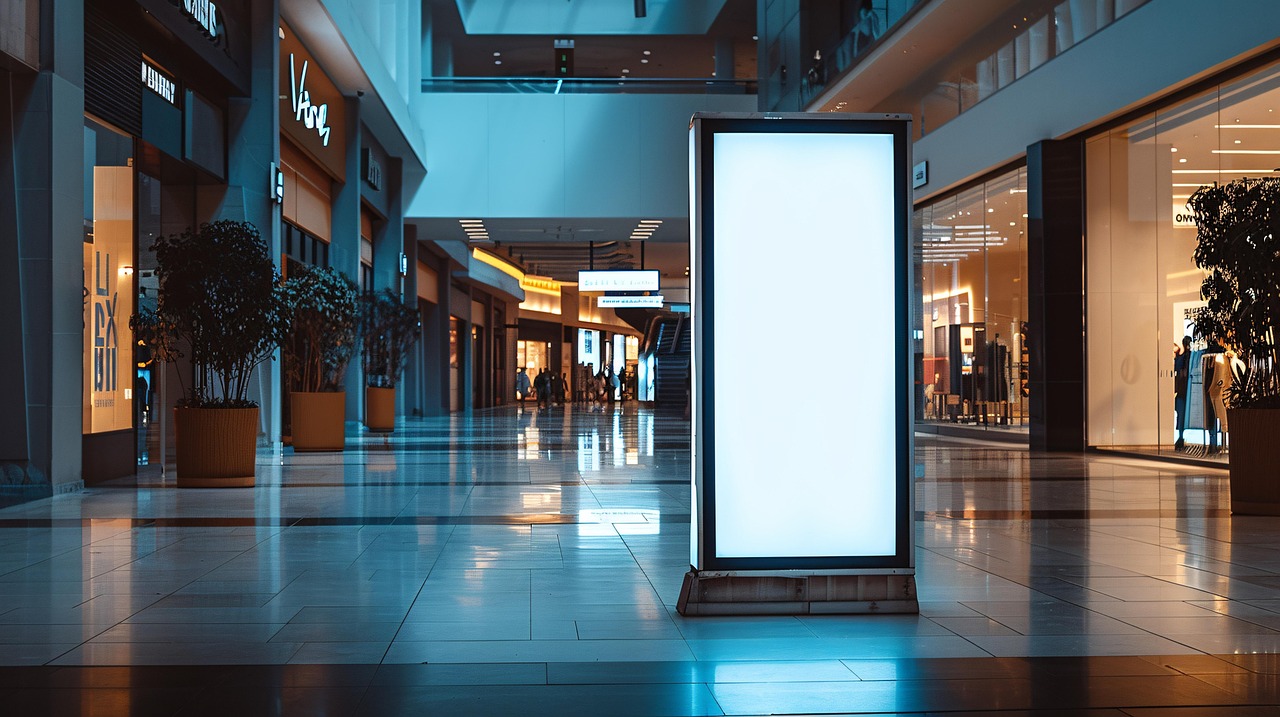
The days of static print and basic digital signage are slowly going out of style; retail visual merchandising is now evolving to tell dynamic and engaging brand narratives that extend from the purely informational to the experiential. Powered by AI, retail experiences now allow brands to connect and resonate with consumers more effectively than before with visual merchandising content that’s not only relevant to the buyer’s journey but also convey a strong and intelligent creative direction.
Imagine AI-powered signage that reacts or adjusts content in real time to help you with your purchasing decision at a store, especially at times when you’re looking at the shelf or aisle and not sure which brand to pick. Dynamic visual merchandising can highlight products based on current popularity or stock to influence your choice. During peak hours, this could mean you’re able to get your hands on the best-selling item before it runs out or select the product with enough available stock if you need to meet a certain quantity. Unlike manual content, which could outdate if the product presented has stocked out, AI-driven merchandising can present alternatives and introduce new brands which would otherwise have been unexplored or missed by consumers.
Emerging technologies such as virtual try-on and augmented reality (AR) add another layer to how customers interact with products. The former uses AI to simulate how clothing or accessories would look like or fit on a customer, while AR helps visualize products in different settings or styles. These technologies help reduce return rates and drive customer satisfaction and brand loyalty.

Copyright: TyliJura
We’ve touched on only a few of the current and noteworthy applications of AI in retail. There are many others, and more will likely be added in the near future as this technology continues to evolve. Embracing AI can reward a brand or company with competitive advantages and success, but the rewards aren’t necessarily reaped overnight. AI saves time, reduces costs, and optimizes sales and operations; but companies need to be strategic, adaptable, innovative, and ethical when harnessing this technology. Not only would a retailer need to invest time, effort, and resources to build the extensive data and foundational systems of their AI infrastructure, they would also need to gain an understanding of how everything connects and works with one another, as well as how it all aligns with their company’s goals.
If you’re a retail company looking for help in adopting AI in the best way possible, Cascade Strategies can assist you in this endeavor. Not only are we well versed in AI technology, we are advocates of “appropriate use of AI.” We appreciate the advantages and benefits AI brings, but we firmly believe that it’s at its most effective when harnessed and guided by human values and experience. Contact us today to learn how Cascade Strategies can help your company enrich retail operations and the shopping experience you offer to your customers with AI.
Featured Image Copyright: Demian Smit
Featured Image Copyright: ArtisticOperations







 info@cascadestrategies.com
 2032 Newport Way NW,
Issaquah, WA 98027 (425) 677-7430